
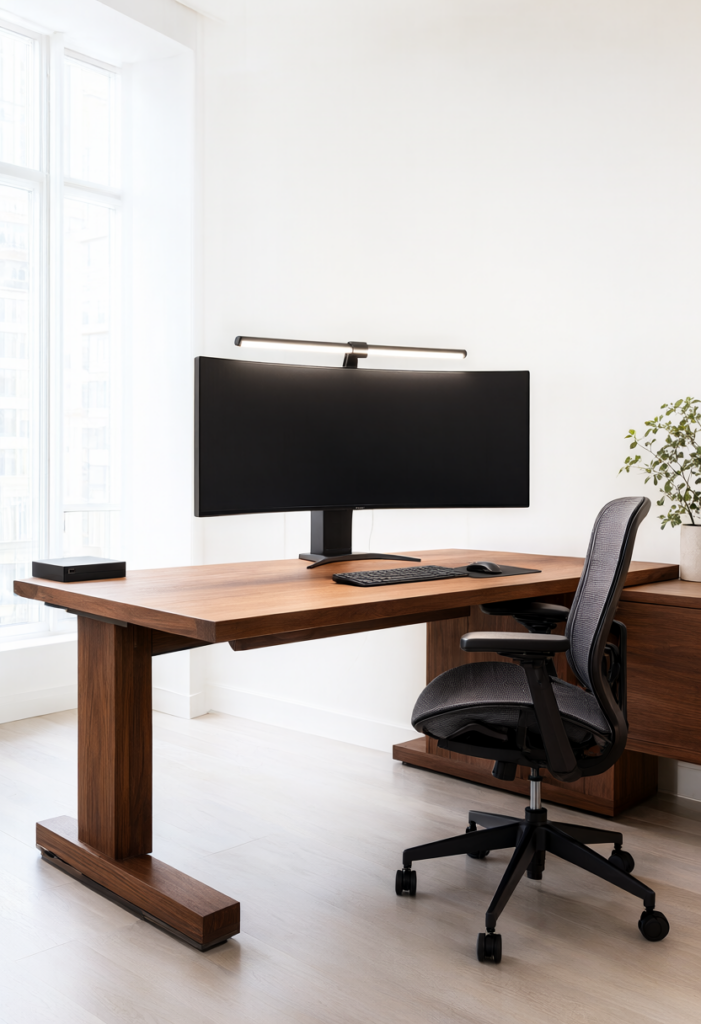
“Visual chaos is cognitive friction. When your physical desk is cluttered with entangled cables and clunky monitors, your executive focus is quietly bleeding bandwidth. A broadcast studio should feel like a contemporary art gallery.”
In an era where executive board meetings, international keynote addresses, and high-stakes media broadcasts occur from home studios, the workspace is no longer merely utilitarian office furniture. It is the architectural stage upon which professional credibility is projected. A camera-ready workspace balances three engineering disciplines: Orthopedic biomechanics, studio-grade soft lighting, and single-cable Thunderbolt architecture.
1. The 90-Degree Orthopedic Geometry

Ring lights produce an unnatural, artificial circular ring reflection in the viewer’s pupils and blast direct, harsh point-source photons into the corneas, causing severe ocular fatigue within two hours. Edge-lit panels bounce light inward against a reflective opalescent plate before diffusing it outward, creating flattering, cinema-grade wrap-around illumination.
What is the ideal desktop depth for maintaining visual comfort with large monitors?
Never buy a desk shallower than 75cm (30 inches) if using a 27-inch to 32-inch monitor. An 80cm depth allows your display to sit at an arm’s length (approximately 60–70cm from the corneas), matching the eye’s natural focal resting point and avoiding ocular convergence strain.

