
“We did not evolve under static 5000K fluorescent tubes. Our biological master clock in the hypothalamus is calibrated by the shifting lux and color temperatures of the celestial sky. Master your photon exposure, and you master your endocrine vitality.”
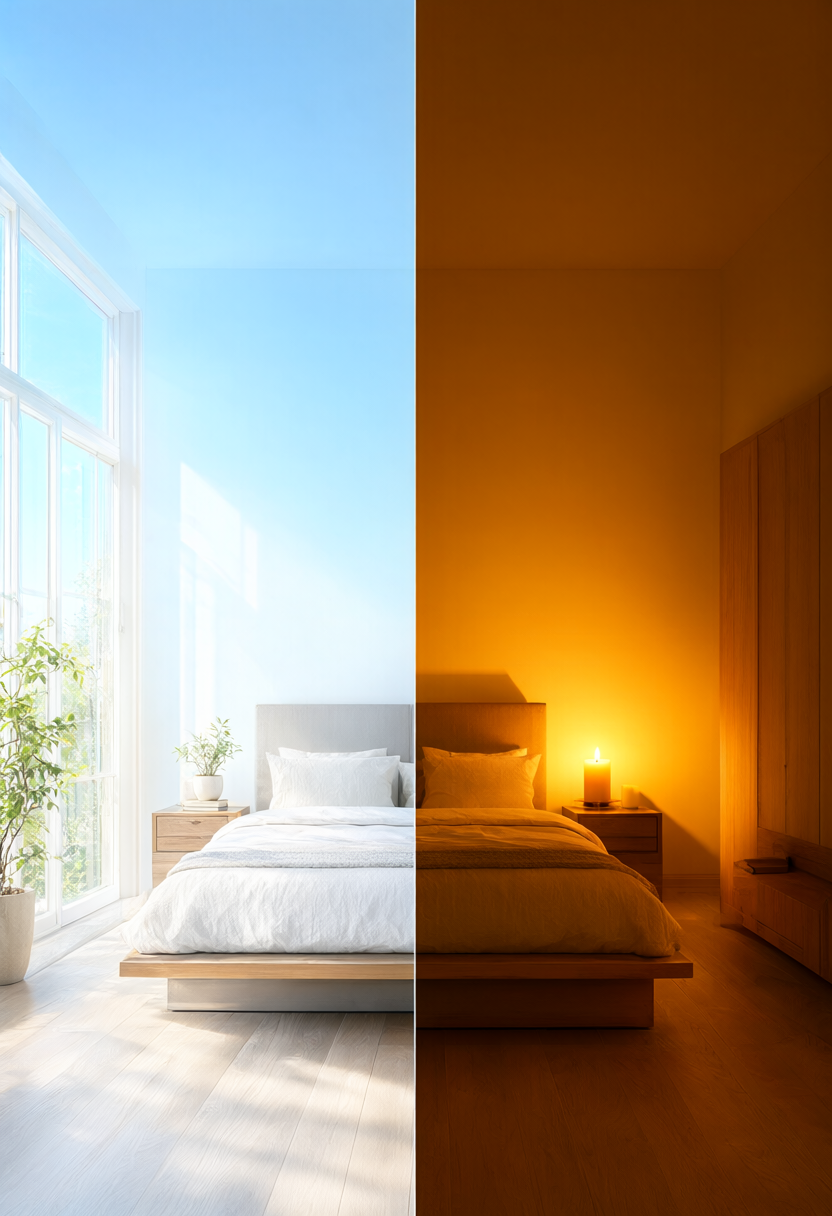
In high-pressure broadcast production, chronic exhaustion is rarely a deficit of hours spent lying in bed; it is an architectural disruption of NREM Stage 3/4 Slow-Wave Sleep. Modern humans spend their days under dim 300-lux indoor office lighting (which the brain interprets as twilight) and their nights bathed in 480nm blue photons from smartphones and LED vanity mirrors (which the brain interprets as high noon). This endocrine confusion blunts morning cortisol surges and delays nocturnal melatonin secretion by up to three hours.
To operate at peak executive cognitive performance, we must engineer our photon environment using the principles of Circadian Light Hygiene.
The Master Switch: Intrinsically Photosensitive Retinal Ganglion Cells (ipRGCs)
No. Modern architectural glass windows and car windshields are treated with specialized UV/visible coatings that attenuate natural light intensity by up to 50–70 times. You would need to sit behind a closed window for nearly two hours to receive the equivalent neurological stimulus of 10 minutes outdoors.
Do orange blue-blocking glasses actually improve deep sleep scores?
Yes, extensive clinical studies tracking sleep with polysomnography demonstrate that wearing high-grade amber/orange blue-blocking lenses (which block 99% of wavelengths below 500nm) for two hours before sleep preserves normal nocturnal melatonin synthesis and increases deep Stage 3/4 slow-wave sleep duration by up to 25%.

